Blog · GPS accuracy
How accurate is GPS speed in your phone?
On a steady open road, your phone's GPS speed is usually closer to your true speed than your car's dashboard — and far more precise than your phone's GPS position. Speed is measured from the Doppler shift of satellite signals, not from dots on a map, and that difference is what makes it so good.
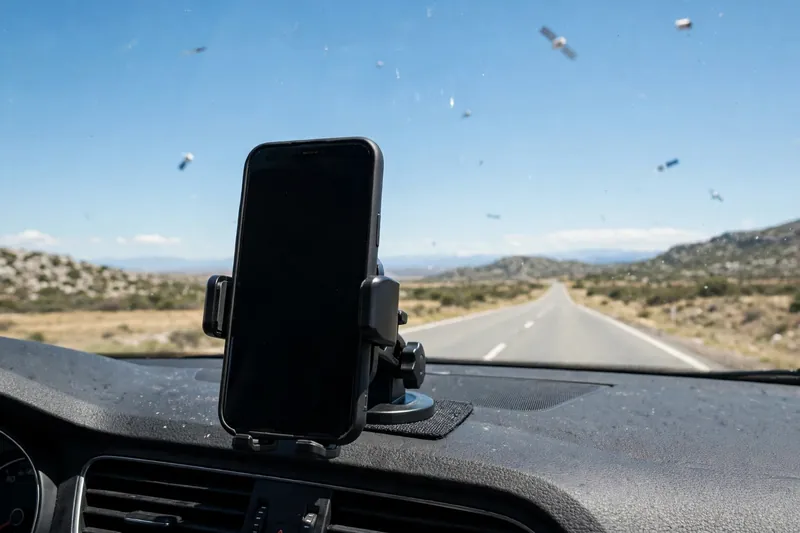
Position and speed are two different measurements
Most people assume a phone works out speed by watching its dot move across a map. It can do that, and it is the simplest method — take two positions, divide the distance between them by the time — but it is also the noisiest. A phone's position is typically accurate to within about 4.9 metres (16 feet) under open sky, according to GPS.gov, and worse near buildings, bridges and trees. Turn a few metres of position error into a speed and you get a jumpy number: the satellite-navigation magazine Inside GNSS puts the accuracy of that simple method at around one metre per second, or about 2.2 mph.
Real receivers take a different route. As you move toward or away from a satellite, the frequency of its signal shifts slightly — the Doppler effect, the same thing that drops the pitch of a passing siren. Measuring that shift gives velocity directly, without depending on two positions being exact. Inside GNSS credits the Doppler method with an accuracy of a few centimetres per second, at least an order of magnitude better than differencing positions. Every serious satellite-based speed measurement relies on it, whether it runs on a phone or on a dedicated timing box.
The numbers are tiny. The civil GPS L1 signal is transmitted at 1,575.42 MHz, and the speed of light is exactly 299,792,458 metres per second. A car driving straight toward a satellite at 60 mph — 26.82 metres per second — shifts the signal by about 141 Hz. That is a change of 0.23 Hz for every 0.1 mph. Your phone measures that shift thousands of times a second, from at least four satellites at once, and turns it into a speed.
What the research says
Independent studies of phone GPS speed do exist, though rarely in cars. A 2025 study of four smartphones (Petrella and colleagues) found speed errors of roughly 0.1 to 0.5 metres per second — about 0.2 to 1.2 mph — which matches the physics: the Doppler measurement is precise, and the remaining error comes from the phone's antenna, its software, and the signal conditions. That is why a phone at a steady 60 mph is usually within about a mile per hour of the truth, while its position on the map may be several metres out.
GPS.gov also publishes the government's own signal standard: the GPS signal in space carries a speed error of no more than 0.006 metres per second over any 3-second interval, 95% of the time. That is the signal in space, not what your phone achieves — the receiver, the antenna and the conditions still decide the real number. But it sets the floor: the measurement itself is capable of far more precision than any dashboard needs.
There is one honest caveat, and it matters for this site: the browser's Geolocation API reports position accuracy in metres only. It does not report a speed accuracy at all. So when our homepage shows you a GPS accuracy radius, that number is about position — it is not a speed accuracy figure, and we do not invent one. The research above is about what the measurement can do; the number on your screen is the position accuracy your device actually reported.
What makes it worse
Four things degrade a phone's GPS speed, and they are all about the signal, not the phone.
Blocked or reflected signals. Between tall buildings, under heavy tree cover, on bridges and in deep valleys, some satellites are hidden and others arrive by bouncing off walls. The fixes get noisy and the speed jumps. The reading usually settles within seconds once you are back under open sky.
No signal at all. In a tunnel, a subway or a parking garage there is no satellite signal, so there is no real speed — the reading freezes or drops to zero. Some navigation apps estimate from the last known position and the map, but that is a guess, not a measurement.
Update rate. Phones typically report a new fix about once a second, so under hard acceleration or braking the reading trails what is happening by a moment. At a steady speed there is effectively no lag, which is why a speed comparison should always be done at a steady cruise.
Cold start. The first fixes after you open a speedometer are often coarse. Outdoors, readings usually settle within seconds to about a minute with assisted GPS, and typically within 2–4 minutes without it. Give the phone that time before you trust the number — and give it a clear view of the sky, not the footwell.
Two smaller effects are worth knowing. On a steep road, GPS measures your horizontal speed, which is slightly less than your speed along the slope — about 0.5% less on a 10% gradient. And dual-frequency GPS (L1 plus L5), which newer phones have, improves accuracy by correcting the signal distortions the atmosphere causes, according to GPS.gov.
GPS speed vs dashboard, side by side
Neither wins everywhere. The honest answer depends on where you are driving:
| GPS speed | Dashboard speedometer | |
|---|---|---|
| How it measures speed | Doppler shift of satellite signals | Wheel rotation × tyre circumference |
| Steady open road | Closer to your true speed | Reads a few percent high, on purpose |
| Tunnel or car park | Freezes or drops to zero | Keeps working |
| City streets | Jumps as signals bounce off buildings | Steady |
| Hard acceleration or braking | Lags a moment behind | Responds at once |
| Near a speed limit | A cross-check, not a calibrated instrument | The regulated instrument — drive by it |
The pattern is simple: GPS is closer to the truth when it can see the sky and your speed is steady, and the dashboard is steadier everywhere else. Use each where it is strong, and do not trust either one blindly where it is weak.
Dual-frequency GPS: what L5 adds
Newer phones carry a second GPS frequency, L5, alongside the older L1. Using two frequencies improves accuracy by correcting the signal distortions the atmosphere causes, according to GPS.gov — the ionosphere slows the two frequencies by different amounts, and comparing them lets the receiver work out how much distortion to remove. The result is a cleaner position fix, and a steadier speed, in exactly the places where single-frequency receivers struggle: cities, tree cover, and anywhere the signal arrives by more than one path.
You cannot choose which frequency your phone uses — the chip decides — and an older phone with L1 only is still accurate enough for a speedometer check on an open road. L5 is a refinement, not a requirement. What matters more than the frequency is the sky: a clear view of it beats any hardware generation, and no receiver, however new, can measure a signal it cannot see.
How to use it properly
The best use of a phone GPS speed reading is checking your car's speedometer. Hold a steady speed with cruise control on a straight, level road for 15–20 seconds, have a passenger record the dashboard and the GPS at the same moment, and repeat at 30, 50 and 70 mph. A dashboard showing 70 mph against a GPS reading of 67 mph is +4.5% — inside the type-approval allowance (UN Regulation 39 countries), and nothing to fix. A dashboard that reads low, or a gap that grows with speed, is worth a proper check.
One more illustration of why the Doppler method matters: take two position fixes one second apart, each off by 5 metres in opposite directions, and differencing them gives you 10 metres per second — 36 km/h, or 22 mph — for a car that is parked. That is the error the position method can make at low speed. The Doppler method does not have that problem, because it never differences two positions. It is the reason a phone can show a steady 0 mph in a car park and a steady 67 mph on a motorway, while its dot on the map wanders by metres. And if your dashboard reads in km/h while your phone reads in mph, convert kmh to mph before comparing the two — and if the units themselves trip you up, here is what kph means.
Finally, repeat the test on a different day before you trust it completely. Satellite geometry changes as the constellation moves, the weather changes how signals travel through the atmosphere, and a road you drove in clear conditions may behave differently in rain or under fresh tree cover. A result that repeats on two different days is a result you can trust; a result from a single drive is a hint.
FAQ
Questions, answered.
01 How accurate is GPS speed on a phone? +
On a steady open road, very accurate — usually closer to your true speed than your car's dashboard. The speed comes from the Doppler shift of satellite signals, which a satellite-navigation journal puts at a few centimetres per second, and a 2025 study of four smartphones found speed errors of roughly 0.1 to 0.5 metres per second, or about 0.2 to 1.2 mph. It is still an estimate, not a calibrated instrument.
02 Why is GPS speed more accurate than GPS position? +
Because they are measured differently. Position comes from timing how long signals took to arrive from several satellites, and a phone's position is typically only within about 4.9 metres under open sky. Speed comes from the Doppler shift — the change in the signal's frequency as you move — which is measured directly and does not depend on two positions being exact.
03 Does GPS speed lag behind my real speed? +
A little, under hard acceleration or braking. Phones typically report a new fix about once a second, so the reading trails a sudden change by a moment. At a steady speed there is effectively no lag. That is why a speed comparison should always be done at a steady cruise, not while you are speeding up or slowing down.
04 Why does my GPS speed jump around in a city? +
Because the signals bounce off tall buildings before reaching the phone — multipath — and some satellites are blocked entirely. The position fixes get noisy, and a noisy position makes a jumpy speed. The reading usually settles within seconds once you are back under open sky. Heavy tree cover, bridges and deep valleys do the same thing on a smaller scale.
05 Does GPS speed work in a tunnel? +
No. Without a satellite signal there is no real speed, so in a tunnel, a subway or a parking garage the reading freezes or drops to zero. Some navigation apps estimate your speed from the last known position and the road, but that is a guess from map data, not a measurement. Your car's speedometer keeps working in a tunnel — GPS does not.
06 Can I trust my phone to check my car's speedometer? +
Yes, on a steady open road — that is the best use of a phone GPS speed reading. Hold a steady speed with cruise control for 15–20 seconds, have a passenger record the dashboard and the GPS at the same moment, and repeat at 30, 50 and 70 mph. A gap of a few percent is normal; a dashboard that reads low, or a gap that grows with speed, is worth a proper check.
07 Is GPS more accurate than a car speedometer? +
At a steady speed under open sky, yes — GPS measures your true ground speed from the Doppler shift, while the dashboard is deliberately set a few percent high and never reads low. In tunnels, cities and stop-start driving the dashboard wins, because GPS lags, freezes or jumps there. Near a speed limit, drive by the dashboard: it is the car's regulated instrument, and GPS is a cross-check, not a calibrated device.
08 Are GPS speedometers legal? +
Using one to check your own speed is legal in most US states, including on a phone or a dashboard display, provided the device is mounted where it does not block your view and you do not handle it while driving. What it cannot do is replace your car's built-in speedometer: no state treats a phone app as the legal equivalent, and hands-free and distracted-driving laws vary by state. Check your own state's rules before relying on one.
Related tools
See how it works, then test it.
Sources
Where the facts came from.
- GhostShift — Is phone GPS speed accurate? How Doppler measures speed (Doppler, not position dots; Inside GNSS: position-differencing ~1 m/s ≈ 2.2 mph, Doppler a few cm/s; Petrella et al. 2025, four smartphones, speed errors ~0.1–0.5 m/s = 0.2–1.2 mph; L1 1,575.42 MHz, 60 mph = 26.82 m/s → shift ≈ 141 Hz)
- GPS.gov — GPS Accuracy (GPS-enabled smartphones typically accurate to within a 4.9 m / 16 ft radius under open sky; accuracy worse near buildings, bridges and trees; dual-frequency improves accuracy by correcting atmospheric distortion; signal-in-space speed error ≤ 0.006 m/s over any 3-second interval, 95% of the time)
- Speedometera — Methodology: How We Measure GPS Speed (Doppler speed first, haversine fallback; fixes worse than ±50 m dropped; below 0.5 m/s counts as standing still; smoothing α = 0.6; cold start settles within seconds to a minute)
- Speedometer.top — How Accurate Is a GPS Speedometer? (1 Hz update rate → trails sudden changes; steep road: horizontal speed slightly less than along-slope, ~0.5% on a 10% gradient; UN R39 type approval: never below true, up to 10% + 4 km/h high)
- UN Regulation No. 39 (EUR-Lex 2025/1902) (type approval, para 5.4: 0 ≤ (V1 − V2) ≤ 0.1·V2 + 4 km/h — dial may read high, never low)
- Edmond Industries — GPS Speedometer Calibration: Can It Serve as Legal Evidence? (using a GPS speedometer app to monitor your own speed is legal in most US states, provided the device is mounted so it does not block your view and you do not handle it while driving)
- LegalClarity — Is It Illegal to Drive With a Broken Speedometer? (FMVSS 101 applies at manufacture; no federal operating requirement for passenger cars; a GPS app is not a legal substitute for the factory-installed speedometer; hands-free laws vary by state)
Last checked: 22 November 2026.