Blog · Speed cameras
Speed camera tolerance: how many mph over is safe?
In the UK, most cameras trigger at the limit plus 10% plus 2 mph — 35 in a 30, 79 on a motorway. But that is guidance, not a right: in law, 1 mph over is already an offence. And in the US there is no national tolerance at all.
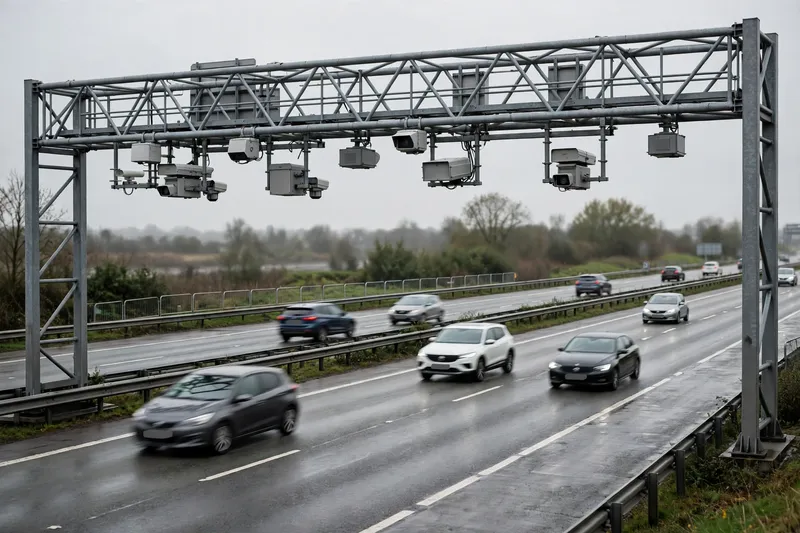
The UK rule: 10% + 2 mph
The figure every UK driver has heard is "10% plus 2". It comes from the National Police Chiefs' Council guidance, which recommends that police forces prosecute only when a driver exceeds the limit by 10% plus 2 mph. On a 30 mph road, the camera would not normally activate unless the car passed at 35 mph or faster. On a 70 mph stretch of motorway, the threshold rises to 79 mph. The full table is the one worth memorising:
| Speed limit | Camera normally triggers at | Speed awareness course offered up to |
|---|---|---|
| 20 mph | 24 mph | 31 mph |
| 30 mph | 35 mph | 42 mph |
| 40 mph | 46 mph | 53 mph |
| 50 mph | 57 mph | 64 mph |
| 60 mph | 68 mph | 75 mph |
| 70 mph | 79 mph | 86 mph |
The third column is the one most drivers miss. Speed awareness courses are offered in many areas for offences up to 10% plus 9 mph — so up to 42 mph in a 30 zone. A course costs money and a morning, but it keeps the points off the licence. Above that threshold, the fixed penalty and the points apply.
The tolerance exists for two reasons. The first is fairness: speedometers and cameras both have small errors, and the authorities do not want to punish a driver for a difference of a mile or two that could be the equipment's fault. The second reason is safety: the authorities do not want drivers so preoccupied with the speedometer that they fail to pay attention to the road. A small buffer lets you watch the traffic instead of the dial.
Why the tolerance is not a right
This is the part that catches people out. The 10% + 2 mph figure is guidance to police forces, not a law. In law you are liable for a speeding fine as soon as you exceed the limit — 31 mph in a 30 zone, or 71 mph on a motorway, is already an offence, and a court can convict on it. Most forces follow the guidance, but a force can set its cameras tighter, and some do. The guidance can also change without notice. The only speed that is certainly safe is the limit itself.
There is also a hidden protection built into the system that most drivers never notice: the dashboard. The law says a speedometer must never show less than the actual speed. Under UN Regulation 39 — the type-approval rule that applies in the UK, the EU and most of the world — it must never show more than 10% above the true speed plus 4 km/h. So if your true speed is 40 mph, your dashboard could legally read up to about 46.5 mph, but never less than 40. A separate UK rule for individually approved vehicles allows 110% plus 6.25 mph. In practice dashboards read 2–4 mph high at motorway speed, which means that if your dashboard says 35 in a 30 zone, your true speed is probably 32 or 33 — inside the tolerance anyway. The system is designed so that you cannot accidentally be travelling faster than your car is telling you. The tolerance and the dashboard margin work together, and they both push in the same direction: toward the driver.
The penalty for getting it wrong is not small. Exceeding the limit by more than 20 mph in a 20 or 30 mph zone can mean a Band C fine — six penalty points and a fine of 125–175% of your weekly income — and disqualification for between 7 and 56 days. The court would normally ban a driver whose speed exceeds twice the limit. None of that is worth the minute you save by driving at 35 in a 30.
Average speed cameras: a different game
Fixed cameras measure your speed at one point. Average speed cameras measure it over a whole stretch: they read your number plate at two points and divide the distance by the time. To stay within the limit you need to average the limit or less over the total distance — which means that speeding up between the cameras and slowing down for them does not work. If you pass the first camera at 50 mph in a 50 zone and then creep up to 55, your average over the stretch will still be over 50 by the end.
Average cameras are also harder to challenge, because there is no single moment to argue about — the measurement is the whole journey between the two points. And they work in any weather, because they only need to read a plate at each end. The practical rule is the same as for fixed cameras: drive to the limit for the whole stretch, not just at the camera.
The US: no national tolerance
The United States has no equivalent of the 10% + 2 rule. Each state, county and city sets its own enforcement practice, and many set none at all — a camera or an officer can ticket you at 1 mph over the limit. Some jurisdictions give a small buffer in practice, often around 10 mph over for camera enforcement, and some states ban speed cameras entirely: Maine, Mississippi, Montana, New Hampshire, South Carolina, South Dakota, Texas and West Virginia are among those with full bans on both red light and speed cameras.
Where cameras are allowed, they are usually restricted to the places where the case for them is strongest: school zones and highway work zones. New York, Rhode Island, Virginia and Maryland often restrict cameras to areas near schools, operating only during school hours. Work-zone cameras run in ten states, with their own thresholds — New York triggers above 10 mph over, Pennsylvania at 11+ mph over — and their own fines, from $20 in Delaware to $425 in Maryland. The pattern is the same as in the UK: the tolerance, where it exists, is a local decision, not a national right. And in those zones the fine itself is often doubled — see where speeding fines double in school and work zones.
The myths that will cost you money
The most persistent myth is that you can beat a speed camera by going very fast — that the camera cannot photograph a car moving too quickly. It was tested by the BBC's Top Gear and busted. For a car to cross the photographed area between two frames it would need to travel at about 600 metres per second, or 1,342 mph — nearly twice the speed of sound. Cameras are designed for motorway speeds and beyond. Going faster only makes the fine bigger and, in the UK, can turn a fixed penalty into a ban.
The second myth is that cameras do not work at night or in the rain. Fixed cameras use infrared flash, which is invisible to the driver and works in the dark, and they work in rain — though heavy rain and spray can reduce the quality of the photograph. Mobile cameras work on straight stretches at up to about two miles, and fixed cameras at about a mile, but neither works around bends or over the brow of a hill. If you cannot see the camera, that does not mean the camera cannot see you.
The honest summary is short. In the UK, drive to the limit and the tolerance will look after you; treat 10% + 2 as a buffer, never as a target. In the US, assume there is no buffer at all until you know the local rule. And in both countries, the cheapest speed through a camera is the posted limit — because the only tolerance that is guaranteed is the one on your own dashboard, and it is already working in your favour.
FAQ
Questions, answered.
01 How many mph over the limit before a speed camera flashes? +
In the UK, most police forces follow the National Police Chiefs' Council guidance: a camera normally triggers at the limit plus 10% plus 2 mph. That means 35 mph in a 30 zone, 46 in a 40, 57 in a 50, 68 in a 60, and 79 on a 70 mph motorway. But it is guidance, not law — a force can set its cameras tighter, and some do. The only speed that is certainly safe is the limit itself.
02 Is the 10% + 2 mph rule a legal right? +
No. In law you are liable for a fine as soon as you exceed the limit, even by 1 mph — 31 in a 30, or 71 on a motorway, is already an offence. The 10% + 2 mph figure is an enforcement threshold: the point at which most forces will normally prosecute. It exists partly so drivers are not punished for tiny speedometer errors, and partly so drivers do not stare at the speedometer instead of the road. It is discretion, not permission.
03 What is the speed camera tolerance in the US? +
There is no national tolerance in the US — each state, county and city sets its own rules, and many set none at all. Some jurisdictions give a small buffer, often around 10 mph over on camera enforcement, and some states ban speed cameras entirely. Work-zone cameras in ten states have their own thresholds: New York triggers above 10 mph over, Pennsylvania at 11+ mph over. Check the rules where you are driving, not a national summary.
04 How accurate are speed cameras? +
Speed cameras measure speed three ways: fixed cameras mostly use radar, which reads the Doppler shift of reflected radio waves; mobile units use radar or LIDAR, which times laser pulses; and average-speed cameras read your plate at two points and divide the distance by the time. Every capture is logged with calibration certificates and reviewed before a ticket is issued, which is why readings hold up in court — challenges usually turn on calibration records or signage, not on the camera being wrong.
05 Do speed cameras work at night and in bad weather? +
Yes. Fixed cameras use infrared flash, which is invisible to the driver and works in the dark, and they work in rain — though heavy rain and spray can reduce the quality of the photograph. Mobile cameras work on straight stretches at up to about two miles, and fixed cameras at about a mile, but neither works around bends or over the brow of a hill. Average speed cameras work in any weather, because they only need to read your plate at two points.
06 Can you beat a speed camera by going very fast? +
No — that is a myth, and a dangerous one. The idea is that the camera cannot photograph a car moving too fast, but the cameras are designed for motorway speeds and beyond: to cross the photographed area between two frames a car would need to travel at about 600 metres per second, or 1,342 mph — nearly twice the speed of sound. The BBC's Top Gear tested the myth and busted it. Going faster only makes the fine bigger.
07 If my speedometer says 46 mph in a 45 mph limit but my true speed is 45 mph, am I speeding? +
No. Enforcement measures your true speed, not the indicated speed on the dashboard, so at a true 45 mph in a 45 mph limit you are not speeding — and GPS speed is a good guide to that true speed. Your dashboard reads high by design: the law says it must never read low, so makers build in a margin. But the reading is not a defence on its own: if your true speed had been over the limit, saying the dashboard showed less would not excuse the offence.
08 Do you get 10% on average speed cameras? +
No. There is no 10% allowance for average speed cameras (SPECS): ANPR cameras read your plate at two points and compare your average speed directly with the limit, so averaging 55 mph in a 50 mph zone is an offence. The 10% + 2 mph figure you hear about is the police enforcement threshold in the UK — guidance about when forces prosecute, not a right — and it is not a buffer added to average-speed readings. Any leeway is police discretion, so drive to the limit throughout.
Related tools
Check your speed against the limit.
Sources
Where the facts came from.
- Calendar UK — What happens if you go past a speed camera? (NPCC 10% + 2 mph: 30→35, 70→79; fixed camera range ~1 mile; mobile ~2 miles; 1 mph over is an offence in law)
- Warwickshire Police — FOI disclosure on speed awareness course eligibility (NPCC guidance: education courses offered for excess speeds up to 10% + 9 mph)
- Highways Industry — Speed camera threshold UK (NPCC 2025 enforcement table: trigger 10% + 2 mph, course up to 10% + 9 mph, court from 10% + 2 mph above the trigger)
- Calendar UK — How often are speed cameras wrong? (speedometer must never read under — UN Regulation 39 type approval allows up to 10% + 4 km/h high)
- MoneyBeach — Speed Camera Leniency (10% + 2 mph is the trigger, not a right; 35 in a 30, 46 in a 40, 79 in a 70)
- Calendar UK — How fast do you need to go to beat a speed camera? (600 m/s = 1,342 mph to beat a frame; Band C fine 125–175% of weekly income, 6 points, disqualify 7–56 days for 20+ mph over in a 20/30 zone)
- Stacker — Are speed cameras legal in your state? (full bans: ME, MS, MT, NH, SC, SD, TX, WV; school zones and work zones the most common permitted uses)
- FHWA — Work zone speed camera guidance (New York work-zone cameras trigger above 10 mph over)
- PennDOT — Work zone speed cameras, policies and regulations (Pennsylvania triggers at 11+ mph over)
- Traffic Enforcement Camera — What is a speed camera? (How speed cameras measure speed (radar Doppler; LIDAR time-of-flight; average-speed ANPR) and why readings hold up in court)
Last checked: 24 November 2026.