Blog · Spare tyre
How fast can you drive on a donut spare, and how far?
50 mph and 50 miles. That is the 50/50 rule for a donut spare, and it is printed on the tyre itself. Some makers allow up to 70 miles, but 50 miles at 50 mph is the limit you should plan around — and the spare is not a tyre you live with.
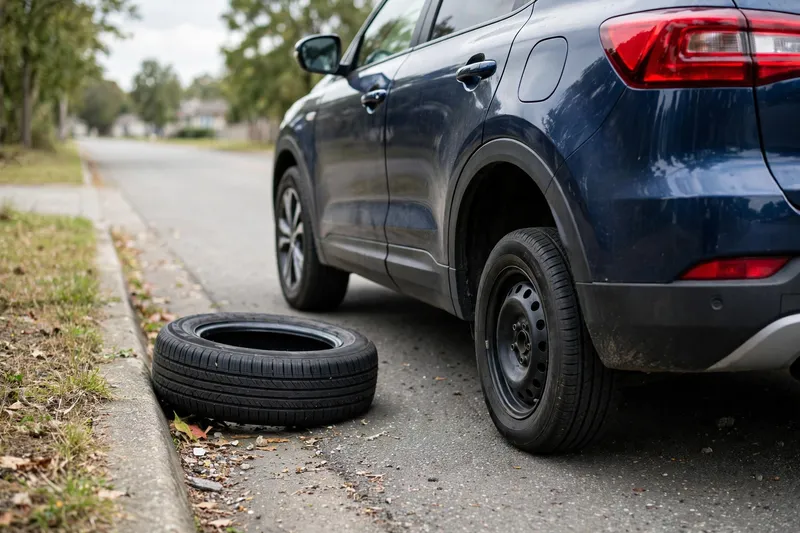
The 50/50 rule
A donut — formally a compact temporary spare — is the small, narrow, lightweight tyre most cars carry instead of a full-size spare. It weighs less and takes up less space, which is why makers fit it. The trade is two hard limits: a maximum speed of 50 mph and a maximum distance of about 50 miles. The speed limit is printed on the sidewall or the wheel, and the distance limit is in the owner's manual. Most makers put the distance at 50 to 70 miles; Kelley Blue Book's advice is to drive no more than 50 miles before replacing it, and Jalopnik puts it the same way — 50 miles, or 70 at the absolute top.
The 50/50 rule is the easy way to remember both numbers: drive less than 50 miles, and keep your speed under 50 mph. At 50 mph, 50 miles takes exactly one hour — which is a useful way to think about it. If the tyre shop is more than an hour away at donut speed, you need a different plan: a tow, a mobile tyre service, or a friend with a full-size spare. The 50 mph cap sits well below most posted limits, so check the speed limit on your route before you set off on the spare.
One number people get wrong is the pressure. Most donuts need 60 psi — nearly double the 32 to 36 psi of a full-size tyre. The high pressure is part of how such a small tyre carries the car's weight. Check the number on the sidewall, not the door sticker: the door sticker is for the regular tyres. And check it before you need the spare. A donut that has sat in the boot for years loses pressure just like any tyre, and a flat spare is no spare at all.
Why the limits exist
A donut is built to a different specification from a real tyre, and every difference is a reason for the limits. It has less rubber, fewer internal reinforcing layers, and a shallower tread — typically only 3/32 to 4/32 of an inch deep on a new donut, against 10/32 or more on a new regular tyre. Its contact patch — the strip of rubber actually touching the road — is much narrower, which means less grip for braking and cornering and a longer stopping distance.
The speed limit is about heat. Above 50 mph the small tyre generates heat faster than it can dissipate it, the structure softens, and the risk of a sudden blowout rises sharply. That is why the limit is a hard 50 mph, not a suggestion: driving a donut at 65 or 70 mph on a motorway is genuinely dangerous, and it is the second flat tyre you cannot fix, because the spare is already on the car.
The distance limit is about the drivetrain. The donut is smaller than the other tyres, so it turns faster than they do, and the differential has to work constantly to absorb the difference. Extended use stresses the differential and, on some cars, the transmission. On an all-wheel-drive car the risk is higher, because the mismatched wheel size fights the AWD system itself — some AWD makers specify even shorter distance limits than 50 miles, and some tell you to disable the AWD system while the donut is fitted.
Donut vs full-size spare vs run-flat
| Spare type | Speed limit | Distance limit | Notes |
|---|---|---|---|
| Donut (compact temporary) | 50 mph | 50–70 miles | 60 psi; reduced grip and braking |
| Full-size matching spare | Normal speeds | No set limit | Same as a regular tyre; check age and pressure |
| Run-flat (after pressure loss) | 50 mph | 50 miles | Same 50/50 limits as a donut |
| No spare (sealant kit) | 50 mph | Short distance only | Only seals small tread punctures |
The table makes the point clearly: only a full-size matching spare has no special limits, and even then you should check its age and pressure before trusting it. A run-flat tyre that has lost pressure has the same 50 mph and 50 mile limits as a donut. And if your car has no spare at all — just a sealant kit and a compressor — the kit only seals small punctures in the tread. It will not fix a sidewall cut or a large hole, and the car still needs to go to a shop at low speed.
Your spare has an expiry date too
A spare tyre ages even if it never touches the road. Rubber breaks down from heat and oxygen, and the tread depth will not warn you — the date code will. The date is the last four digits of the DOT code on the sidewall: the first two are the week, the last two are the year. A tyre stamped 2923 was made in the 29th week of 2023.
The guidance is consistent across the industry. Michelin and Bridgestone recommend replacing tyres, including spares, at about 10 years from manufacture, regardless of remaining tread or appearance — and Michelin says to have them inspected by a professional at least once a year after five years. Ford, Nissan and Mercedes-Benz tell owners to replace at six years. Consumer Reports' tyre programme manager puts it plainly: get a new spare at 10 years to make sure it is safe to use, and inspect it periodically for cracking or dry rot. A donut that has sat in a hot boot for eight years may look new and still be past its safe life.
How to drive on a donut
Drive gently. The narrow tread gives you less grip in every direction: longer braking distances, less cornering stability, and much less grip in the wet. Some guides put the wet-weather limit at 30 mph. Brake earlier than usual, corner slower than usual, and leave a bigger gap than usual — the same 4-second gap a rental truck needs is a good starting point.
Avoid the motorway if you can. At 50 mph you will be much slower than the traffic around you, and that speed difference is itself a hazard. Take the shortest route to the nearest tyre shop, stay in the slow lane, and turn on the hazard lights if you are well below the flow of traffic. Avoid rough roads and bad weather — the donut's shallow tread and narrow patch are at their worst on a wet or broken surface.
And do not treat the donut as a tyre you can live with for a week. Keeping it on for a day or two until you can get to a shop is acceptable only if you stay under 50 miles in total. After one use past its limits, treat the donut as spent — replace it rather than putting it back in the boot for next time. The donut is a bridge to the tyre shop, not a replacement for the tyre you lost.
The check that costs nothing: go and look at your spare today. Is it there? Is it inflated? Do you know where the jack and the wheel brace are, and have you ever used them? The worst time to discover a flat spare, a missing jack or a seized wheel nut is on a hard shoulder at night in the rain. Five minutes in the driveway now is worth an hour on the roadside later.
FAQ
Questions, answered.
01 How fast can you drive on a donut spare tire? +
No faster than 50 mph. Nearly every compact temporary spare carries a maximum speed of 50 mph, printed on the sidewall or the wheel, and the owner's manual says the same. Above 50 mph the narrow tyre generates heat faster than it can shed it, and the risk of a blowout rises sharply. In wet or snowy weather, stay well below 50 mph — some guides put the wet-weather limit at 30 mph.
02 How far can you drive on a donut spare? +
About 50 miles — most makers say 50 to 70 miles, and your owner's manual gives the figure for your car. The 50/50 rule is the easy way to remember it: less than 50 miles, under 50 mph. A few sources say you can push a donut to 70 miles in an emergency, but that is the absolute top, not a target. Drive the shortest practical distance to a repair shop.
03 Why is a donut spare limited to 50 mph and 50 miles? +
Because it is built to a different specification from a real tyre: less rubber, fewer reinforcing layers, a shallower tread — typically only 3/32 to 4/32 of an inch deep — and a much narrower contact patch. It is engineered to get you from the flat tyre to the nearest repair shop, not to serve as a replacement. The smaller size also makes the differential work harder, because the wheels turn at different speeds.
04 Can I drive on a donut spare on the highway? +
Only for a short distance, and only under 50 mph — which means you will be much slower than highway traffic. That is itself a hazard, so take the shortest route to the nearest exit and repair shop, stay in the slow lane, and turn on your hazard lights if you are well below the flow of traffic. Avoid the highway entirely if a slower road will get you to a shop.
05 What pressure should a donut spare be inflated to? +
Usually 60 psi — nearly double the 32 to 36 psi of a full-size tyre. The high pressure is part of how such a small tyre carries the car's weight. Check the number on the sidewall, not the door sticker: the door sticker is for the regular tyres. And check it before you need the spare — a donut that has sat in the boot for years loses pressure just like any tyre.
06 Can I drive on a donut spare for a week? +
No. A donut is a temporary emergency tyre, not a tyre you live with. Keeping it on for a day or two until you can get to a tyre shop is acceptable only if you stay under 50 miles in total. Beyond that you risk the tyre itself, the differential and the transmission — and on an all-wheel-drive car the risk is higher, because the mismatched wheel size fights the AWD system. Some AWD makers specify even shorter limits.
Related tools
Tyres, braking and your dashboard.
Sources
Where the facts came from.
- Kelley Blue Book — How Long Can You Drive on a Spare Tire? (50/50 rule: less than 50 miles, under 50 mph; run-flats same 50/50)
- Motoring Chronicle — How Fast Can You Drive on a Spare Tire? (50 mph max, 50–70 miles; 60 psi vs 32–36 psi regular; 200 miles on a donut risks failure)
- Jalopnik — How Long Can You Drive On A Doughnut Spare? (50 mph, 50 miles, up to 70 in extreme cases)
- SimpleTire — How Long Can You Drive On A Spare Tire? (50 mph, 50 miles, 60 psi; 30 mph in wet or snow; differential stress from smaller tyre)
- SlashGear — What Is The 50-50 Rule For Spare Tires? (the 50/50 rule: not more than 50 miles, not more than 50 mph)
- Miami Auto Care Center — How Long Can I Drive on a Spare Tire? (tread depth 3/32–4/32 on a new donut; AWD makers sometimes specify shorter limits; full-size spare has no special limits)
- Discover1st — Spare Tire Age Checks (Michelin and Bridgestone: replace at about 10 years from manufacture regardless of tread; inspect yearly after 5 years; DOT code last four digits = week + year)
- SlashGear — Do Spare Tires Expire? (Consumer Reports: new spare at 10 years; inspect periodically for cracking or dry rot; spare ages even if never used)
- Ford — Tire Replacement (replace tyres every six years; replace the spare after six years even if it has not been used)
Last checked: 22 November 2026.