Blog · Rental trucks
How fast can you drive a rental truck? U-Haul, Penske, Budget
As fast as the posted limit — in most states. But some states set a lower limit for trucks, U-Haul caps all towing at 55 mph, and the rental company itself tells you to drive slower than you would in a car. The legal limit and the safe speed are not the same number.
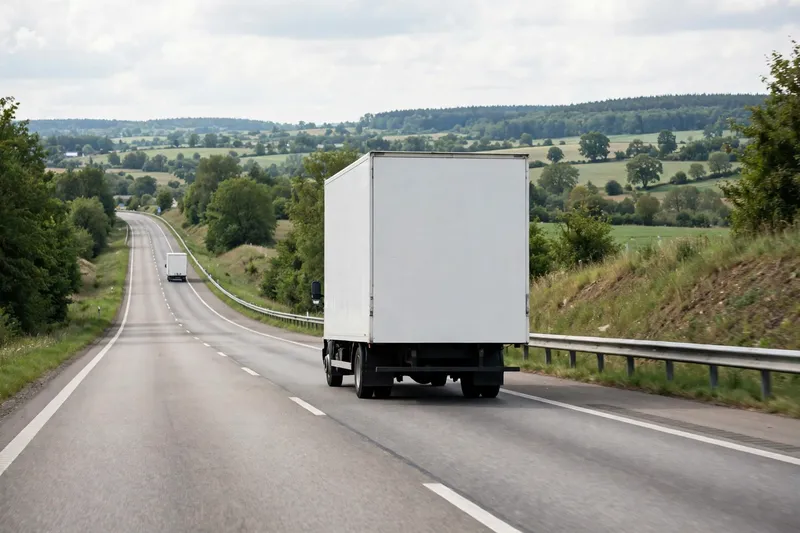
The legal answer: the posted limit, unless the state says otherwise
A rental moving truck is a normal vehicle in the eyes of the law, and in most states it follows the same posted speed limits as a car. The maximum limits on rural interstates range from 60 mph in Hawaii to 85 mph on some Texas roads, and a rental truck can legally drive at those limits where they apply. There is no national rental-truck speed limit, and no federal rule that caps a moving truck below the posted speed.
The exception is the states that set separate truck limits. According to the Insurance Institute for Highway Safety, California's truck limit is 55 mph and Washington's is 60 mph on rural interstates, and Arkansas, Indiana, Michigan, Montana and Oregon also list separate truck limits. Each state defines which trucks the limit covers — often by weight or number of axles — so the rule that applies to a 26-foot box truck may not apply to a 10-foot van. The sign to watch for is the one marked TRUCKS: where a separate truck limit exists, it is posted beside the car limit, and it is the truck number that binds you.
That is the legal answer. It is not the whole answer, because a loaded truck does not behave like a car. It takes longer to stop, it is pushed around by wind, and its centre of gravity sits high above the road. Every rental company says the same thing in its instructions: drive slower than you would drive a car under the same conditions. U-Haul's guidance is explicit — follow the posted limits, and reduce speed when the truck is fully loaded.
Towing: 55 mph, no exceptions
The one hard number in rental-truck driving is the towing limit. U-Haul's maximum recommended speed is 55 mph when towing any of its trailers, and the same 55 mph maximum applies to its tow dollies and auto transports. The limit applies whether you tow with a U-Haul truck or with your own vehicle, and you go slower where a posted or state limit is lower.
The 55 mph figure is not just company policy. Several states set 55 mph as the legal limit for vehicles drawing a trailer — in California, for example, any truck or passenger vehicle drawing another vehicle is limited to 55 mph. So in those states the company's rule and the law agree, and in the rest the company's rule is the stricter one. Either way, 55 mph is the number to remember when anything is hitched behind you.
The reason is stability. A trailer at 70 mph is a different machine from a trailer at 55 mph: crosswinds push it sideways, a bump can start it swaying, and once a trailer starts swaying the only fix is to slow down gently — braking hard makes it worse. At 55 mph the forces are smaller, the sway is slower to start, and you have time to catch it. Go slower than 55 in wind, rain, on downgrades and in heavy traffic. And leave more room than usual: U-Haul's trailer safety guide suggests at least a 5-second following distance when towing, a second more than the 4-second gap for the truck alone.
Governors: what the truck itself will allow
U-Haul's own trucks do not have a speed limiter, according to the company's guidance — the truck will go as fast as the posted limit allows, and the restraint is supposed to come from the driver. Penske and Budget are different: renters report speed governors around 65–68 mph on Penske trucks and around 65 mph on Budget trucks, though it varies by truck, location and fleet, and the companies do not publish a single figure. Ask the dealer when you pick up — they will tell you where the governor is set on your truck.
A governor changes the maths of a long move. A 1,000-mile drive at a steady 65 mph takes 15.4 hours of driving; at 70 mph it takes 14.3 hours. The difference is about an hour — not nothing on a two-day move, but not worth fighting the truck for. And a governed truck is telling you something: the rental company has decided that speed is where its trucks get into trouble, and it has taken the choice out of your hands.
Do you need a special licence?
No — not for a personal move in a rental truck. Under the federal commercial driver's licence rules (49 CFR 383), a Class B CDL starts at a single vehicle with a gross vehicle weight rating of 26,001 pounds or more. U-Haul's biggest truck, the 26-footer, is rated at 25,999 pounds — two pounds under the line, on purpose. It carries a maximum load of 12,859 pounds on an empty weight of 13,140 pounds, and U-Haul says a standard driver's licence is all you need. You must be at least 18, with a valid licence, a second form of ID and a payment method. Penske's 26-foot truck is the same story: a regular licence and two forms of ID, with up to 10,000 pounds of load.
Two warnings. First, the rating is what matters, not the size: a commercial 26-foot box truck can be rated at 33,000 pounds, which does need a CDL — so read the door sticker on the truck you actually rent, and do not assume. Second, your state can add its own rules, and business use brings in federal motor carrier rules that a personal move avoids. If you are moving goods for pay, the licensing question is different, and you should check with your state's DMV before you book.
How fast you should actually drive
The number that matters most is not the speedometer reading but the gap in front of you. U-Haul tells renters to keep at least a 4-second gap to the vehicle ahead, or 5 seconds in rain, snow or fog. At 60 mph, 4 seconds is about 350 feet — roughly 24 car lengths. That sounds enormous until you remember what a loaded truck needs to stop: more weight, more momentum, and brakes sized for a vehicle that spends most of its life empty. If a car cuts into the gap, ease off and rebuild it rather than closing up.
On hills, the rule changes again. On a long climb, U-Haul tells renters to stay in the slow lane and turn on the hazard flashers if speed drops below 45 mph while other traffic is faster. A loaded truck climbing at 45 mph is not a problem — it is the truck doing what it is built to do. Downhill is the dangerous direction: pick a low gear that holds the speed, and use the brakes in short bursts rather than riding them, because a loaded truck's brakes overheat fast on a long downgrade.
Wind is the last one people forget. A 26-foot box truck is a sail, and a crosswind gust at 70 mph pushes it sideways with a force a car driver never feels. In strong wind, slow down before the gust hits you, keep both hands on the wheel, and leave extra room beside you. The posted limit assumes a car in calm air. A loaded box truck in a crosswind is neither.
The short version: drive to the posted limit or the state truck limit, whichever is lower; never tow above 55 mph; keep a 4-second gap; and on hills and in wind, slow down before you have to. The move takes an hour longer. The truck, the load and the people in it arrive in one piece.
Related reading: how fast can you drive on a donut spare — the 50 mph / 50 mile limits if a tyre fails mid-move.
FAQ
Questions, answered.
01 Is there a speed limit for rental trucks? +
There is no single national rental-truck speed limit. In most states a rental truck follows the same posted limits as a car, and the maximum on rural interstates runs from 60 mph in Hawaii to 85 mph on some Texas roads. But some states set lower limits for trucks: California's truck limit is 55 mph and Washington's is 60 mph on rural interstates, and Arkansas, Indiana, Michigan, Montana and Oregon also list separate truck limits. Watch for signs marked TRUCKS.
02 How fast can I tow a U-Haul trailer? +
No faster than 55 mph. U-Haul's maximum recommended speed is 55 mph for all of its trailers, tow dollies and auto transports, whether you tow with a U-Haul truck or your own vehicle — and slower where a posted or state limit is lower. Several states also set 55 mph as the legal limit for vehicles towing a trailer, so the 55 mph figure is both the company's rule and, in many places, the law.
03 Do U-Haul trucks have a speed governor? +
U-Haul's own trucks do not have a speed limiter, according to the company's guidance — the truck will go as fast as the posted limit allows, and the company tells you to drive slower than you would in a car. Penske and Budget trucks are a different story: renters report governors around 65–68 mph on Penske trucks and around 65 mph on Budget trucks, but it varies by truck, location and fleet, so ask the dealer when you pick up.
04 How much following distance should I leave in a rental truck? +
U-Haul tells renters to keep at least a 4-second gap to the vehicle ahead, or 5 seconds in rain, snow or fog. That is double the 2-second gap most drivers use in a car, and it is there because a loaded truck takes much longer to stop. At 60 mph, 4 seconds is about 350 feet — roughly 24 car lengths. If a car cuts into that gap, ease off and rebuild it rather than closing up.
05 Can I use cruise control in a rental truck? +
U-Haul does not list cruise control as a feature of its trucks, and the equipment varies by location — your dealer can tell you whether the truck you are renting has it. Even if it does, U-Haul says not to use it in heavy traffic, on winding roads, when towing, in slippery conditions, or while driving up or down hills. On a long, flat, empty stretch it is fine; everywhere else, keep your foot on the pedal.
06 What speed should I drive a loaded truck downhill? +
Slower than the limit, in a low gear, with the brakes used in short bursts rather than held down. A loaded truck gains speed fast on a downgrade and its brakes overheat if you ride them. U-Haul tells renters to stay in the slow lane on long climbs and to turn on the hazard flashers if speed drops below 45 mph while other traffic is faster. The same thinking applies downhill: pick a gear that holds the speed, and let the engine do the braking.
Related tools
Plan the drive, then drive it.
Sources
Where the facts came from.
- Moving.tips — How Fast Can You Drive a Moving Truck or U-Haul? (posted limits by state; CA truck 55 mph, WA 60 mph per IIHS; AR, IN, MI, MT, OR separate truck limits; U-Haul 4-second gap, 5 s in rain/snow/fog; trailer/tow dolly/auto transport max 55 mph; flashers below 45 mph on climbs)
- U-Pack — How Fast Can I Drive a U-Haul Truck? (U-Haul: follow posted limits, reduce speed loaded; trailer max 55 mph; cruise control not listed as a feature; some trucks governed — ask dealer)
- AnswerBarn — Can U-Haul Trucks Go on the Highway? (U-Haul trucks have no speed limiter; trailers 55 mph max)
- ProSoundWeb forum — Rental Truck Top Speed (renter reports: Penske/Hertz governors ~68 mph, Budget ~65 mph — renter reports, not company policy)
- MoveDayPlan — Do you need a CDL for a 26 ft moving truck? (49 CFR 383 Group B threshold 26,001 lb; U-Haul 26 ft rated 25,999 lb max, 2 lb under; max load 12,859 lb; standard licence, 18+)
- U-Haul — Safety Tips for Driving with a Trailer (55 mph towing max; at least a 5-second following distance when towing; cruise control not recommended while towing)
- TruckPacker — No CDL for a 26-Foot Box Truck Under 26,001 Pounds (U-Haul 26 ft: 25,999 lb GVWR, empty 13,140 lb, max load 12,859 lb; Penske 26 ft: regular licence + 2 IDs, up to 10,000 lb load; commercial 26 ft box can run 33,000 lb)
Last checked: 22 November 2026.