Blog · Police radar
How accurate is police radar? Can a speeding ticket be wrong?
Yes, a speeding ticket can be wrong — but a calibrated radar used properly is accurate to about 1 mph. The mistakes come from the conditions around the radar, not the radar itself: the wrong car, a moving patrol car, a missed calibration, or an officer who did not do the daily check.
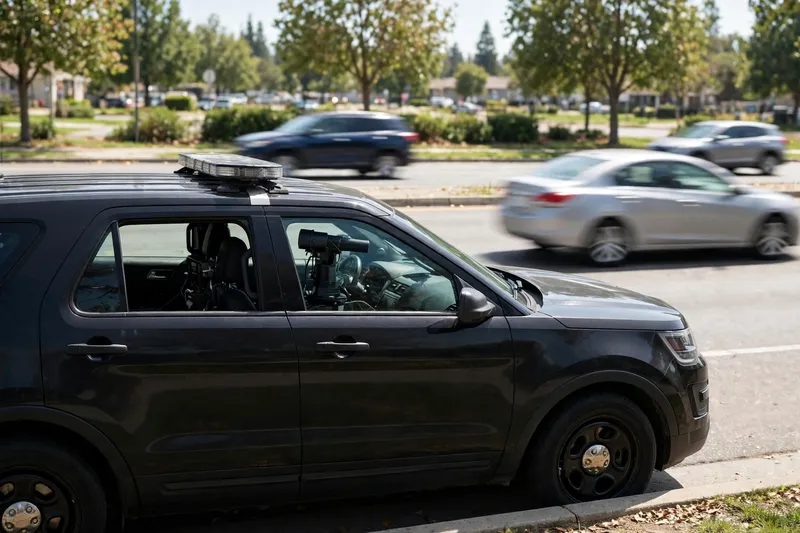
How radar measures your speed
Police traffic radar works on the Doppler effect, the same physics our GPS speed guide explains for satellites. The unit sends out a microwave beam at a fixed frequency. The beam hits your car and bounces back, and because your car is moving, the returning signal is shifted in frequency. The bigger the shift, the faster you are going. The unit converts the shift into a speed and shows it on a digital display.
The important limitation is in the beam. Police radar uses a single stationary antenna pointing in one direction, and its beam is wide — it covers several lanes and several cars at once. The unit reports one number: the speed of the strongest signal it received. It does not tell the officer which car produced that signal, or even which direction the car was travelling. The officer has to decide that by looking at the road, and that judgement is where most radar errors begin. Whatever the reading, the number it is judged against is the posted speed limit for that road.
LiDAR — the laser gun — works differently. It sends a narrow infrared beam at one car and measures how long the light takes to return, several times a second. Because the beam is narrow, it targets a single vehicle, and it works at longer range than radar. That is why LiDAR is harder to challenge on target identity. But it has its own limits: it needs a steady aim, a clear line of sight, and it is calibrated on a schedule just like radar.
One more number worth knowing before the errors: manufacturers certify most radar units to about ±1 mph when stationary, and about ±2 mph in moving mode — the published specification for Kustom Signals' Raptor RP-1, for example. That is the instrument's own tolerance, before any of the errors below. A reading that is further out than that is not the radar being a little imprecise; something else went wrong.
The 13 ways radar goes wrong
The National Bureau of Standards tested the six most popular police radar models in 1980 and found that all of them produced false readings in the presence of CB or police radios, and every two-piece unit produced panning errors. The International Association of Chiefs of Police tested 24 models in 1983 and 1984: nearly all were affected by temperature variation, five failed accuracy tests, four had unacceptably wide beam widths, and three gave inaccurate readings near police radios. Those tests are old, and modern units are better — but the error types they found are still the ones lawyers argue about today.
The thirteen error types most often listed are: panning, when the hand-held unit is swept across the dashboard; mechanical interference, from the patrol car's fan, alternator or ignition, or from rotating signs near the road; shadowing, where a moving radar unit adds some of the patrol car's own speed to the target's; batching, when the patrol car is speeding up or slowing down while the unit is still calculating; radio or microwave interference, from CB and police radios, airport radar, cell phones, power lines and neon lights; auto-lock on the wrong target, when the unit locks onto a larger or closer vehicle instead of yours; and the rest — cosine error from an angled beam, double-bounce reflections, fan and heater motors, and operator error.
The famous examples are from 1979, when a Miami television station showed a radar gun clocking a palm tree at 86 mph and a house at 28 mph. The palm tree reading came from panning the antenna; the house reading came from the unit measuring the fan motor in the patrol car. Nobody would run those tests today and expect the same results — modern units have filters for exactly these errors — but the stories survive because they show the principle: radar measures a signal, not a car, and a signal can come from anywhere.
One estimate that gets quoted a lot comes from RADAR, a non-profit advocacy group, whose brochure says some experts estimate that 10–20% of radar-backed speeding tickets are issued in error, and up to 30% for radar operated from a moving police vehicle. Treat that as an advocacy estimate, not a measured fact: it is a group's claim, not a study. But it is also the reason the calibration and training rules exist — the system knows radar can be wrong, and it built checks around that fact.
Calibration: the schedule that keeps radar honest
The defence against radar error is not better radar. It is paperwork. Florida's rules are typical: radar and laser devices must be professionally calibrated every six months by an FCC-certified technician, who inspects the unit, verifies it is working properly, and issues a calibration certificate. Officers are expected to bring that documentation to court, and if it is unavailable, the prosecution has a real problem.
The checks do not stop at six months. Before and after using radar or laser during a shift, officers must perform daily operational checks: testing radar units with certified tuning forks, testing both stationary and moving modes where they apply, verifying laser accuracy against known distances, completing radar logs that document the tests, and making sure the patrol vehicle's own speedometer is properly calibrated when moving radar is used. A tuning fork is a piece of metal cut to vibrate at a frequency that simulates a known speed — 35 mph, say — so the officer can confirm the unit reads 35 when it should.
That is why the first question in a radar challenge is never "was the radar right?" but "where is the calibration certificate, and where is the tuning-fork log for that shift?" A missing certificate or a skipped daily check is a stronger defence than arguing about the physics, because the court accepts radar as accurate only when the checks are documented.
Can your GPS prove the radar wrong?
Almost never, and you should not rely on it. The reason is a measurement difference, not a conspiracy. Radar measures your instantaneous speed — your exact speed at one moment. GPS calculates an average over a short window, updating every 1–3 seconds. A radar gun catches the peak speed in a single second; your GPS average over that window can be lower, because it smooths the peak away. If you accelerated hard for one second inside the GPS window, the radar saw the peak and the GPS did not.
Courts treat police radar as the approved instrument and consumer GPS as a convenience, not evidence. Waze is weaker still as evidence, because it is a third-party app showing aggregated data from other people's phones. A GPS log can support a challenge — for example, if it shows you were consistently at 60 mph for minutes around the stop, and the radar said 80 — but on its own it does not beat a calibrated radar. The right way to use GPS is the way this site's tools use it: to know your own speed, so you do not get the ticket in the first place. Drive to the GPS number, which is closer to what the police will measure, and leave a margin.
If you do get a ticket you believe is wrong, note everything at the time: where you were, how fast you were going, what traffic was around you, and whether the officer was moving or stationary. Then ask for the evidence — the calibration certificate, the tuning-fork log, the officer's training record. And if the stakes are high — points, a licence suspension, a commercial licence — get a lawyer. Radar is usually right. When it is wrong, the proof is in the paperwork. Points from a ticket can also push up what you pay for cover, so it is worth knowing whether car insurance tracks your speed.
FAQ
Questions, answered.
01 How accurate is police radar? +
When it is calibrated, operated correctly and aimed at the right car, police radar is accurate to within about 1 mph — the devices are built to that standard and checked against it. The accuracy comes with conditions: the officer must be trained, the unit must be calibrated on schedule, and the road must be flat, straight and clear. When any of those conditions fails, the reading can be wrong, and the error is usually in the direction that hurts the driver.
02 Can a speeding ticket be wrong? +
Yes. Radar measures the speed of the strongest signal it receives, not necessarily your car: in traffic it can lock onto a larger or closer vehicle, and in moving mode it can add some of the patrol car's own speed to yours — an error called shadowing. Calibration lapses, a panning antenna, interference from radios or machinery, and a unit used in instant-on mode all produce wrong readings. That is why courts ask for calibration records, not just the number on the display.
03 What is the difference between radar and LiDAR? +
Radar sends out a wide microwave beam and measures the Doppler shift of whatever reflects it strongest — it cannot tell which car in the beam produced the reading. LiDAR sends a narrow infrared laser beam at one car and measures the time the light takes to return, so it targets a single vehicle and works at longer range. LiDAR is harder to challenge on target identity, but it needs a steady aim and a clear line of sight, and it is also calibrated on a schedule.
04 How often must police radar be calibrated? +
It varies by state, but the pattern is the same everywhere: a professional calibration on a fixed schedule, plus a daily check before use. Florida requires professional calibration every six months by an FCC-certified technician, with a certificate the officer is expected to bring to court. Before and after each shift, officers test the unit with certified tuning forks, and in moving mode they also verify the patrol car's own speedometer. If the paperwork is missing, the prosecution has a problem.
05 Can my GPS speed prove the radar was wrong? +
Almost never, and you should not rely on it. Radar measures your instantaneous speed — your exact speed at one moment — while GPS calculates an average over a short window, updating every 1–3 seconds. A radar gun catches the peak speed in a single second; your GPS average over that window can be lower. Courts treat radar as the approved instrument and consumer GPS as a convenience. A GPS log can support a challenge, but it does not beat a calibrated radar on its own.
06 What should I do if I think the radar reading was wrong? +
Note everything at the time: where you were, how fast you were going, what traffic was around you, and whether the officer was moving or stationary. Then ask for the evidence: the calibration certificate, the tuning-fork test log for that shift, and the officer's training record. A missing calibration certificate or a skipped daily check is a stronger defence than arguing about the physics. And get a lawyer if the stakes are high — points, a licence suspension or a commercial licence are worth professional help.
Related tools
Know your own speed, before the radar does.
Sources
Where the facts came from.
- Kustom Signals — Raptor RP-1 (manufacturer specification: system accuracy stationary ±1 mph, moving +1/−2 mph)
- Gans Law — Florida Speeding Ticket Myths: Radar & Laser (Florida: professional calibration every 6 months by FCC-certified technician; daily tuning-fork checks before/after shift; shadowing effect; instant-on defeats detectors)
- RADAR (Radio Association Defending Airwave Rights) — Blind Trust (advocacy brochure — attributed, not stated as fact: 10–20% of radar tickets estimated in error, up to 30% moving radar; 1979 Miami TV: palm tree 86 mph, house 28 mph; NBS 1980 and IACP 1983–84 test results)
- MadJack Sports — Speeding Ticket Question (13 radar error types: panning, mechanical interference, shadowing, batching, radio/microwave interference, auto-lock on wrong target)
- NextLaw — Officer's Radar vs Your GPS, Waze, or Speedometer (instantaneous vs averaged speed; courts do not accept GPS as evidence)
Last checked: 22 November 2026.