Blog · Cruise control
How does cruise control work?
You set a speed; the car reads its road speed from a wheel or transmission sensor and adjusts the throttle — opening it when you slow, closing it when you speed up — to hold that speed without your foot. Adaptive cruise control adds a forward sensor that watches the car ahead and slows you to keep a gap.
The loop: sense, compare, adjust
Every cruise control system, from a 1958 Imperial to a car built this year, runs the same three-step loop many times a second:
- Sense. A speed sensor — on modern cars, the wheel-speed sensors that also feed the anti-lock brakes — reports how fast the car is actually going.
- Compare. The control unit compares that speed with the speed you set. Too slow? Too fast? By how much?
- Adjust. It moves the throttle to close the difference: more throttle to speed up, less to slow down. On modern cars with electronic throttles this is a software command; on older cars a vacuum servo or a small electric motor pulled the throttle cable.
The loop never stops while the system is engaged, which is why the speed stays so steady. Your foot cannot do this: you notice the speed has drifted only after it has already changed, then you correct, overshoot, and correct again. The system notices the drift in milliseconds and corrects in tiny steps, so the needle barely moves.
The one thing a conventional system cannot do is brake. It can only close the throttle and let the car slow on its own. That is why it cannot hold your speed down a steep hill — gravity wins, and the car creeps over the set speed until you brake yourself.
The controls on your wheel
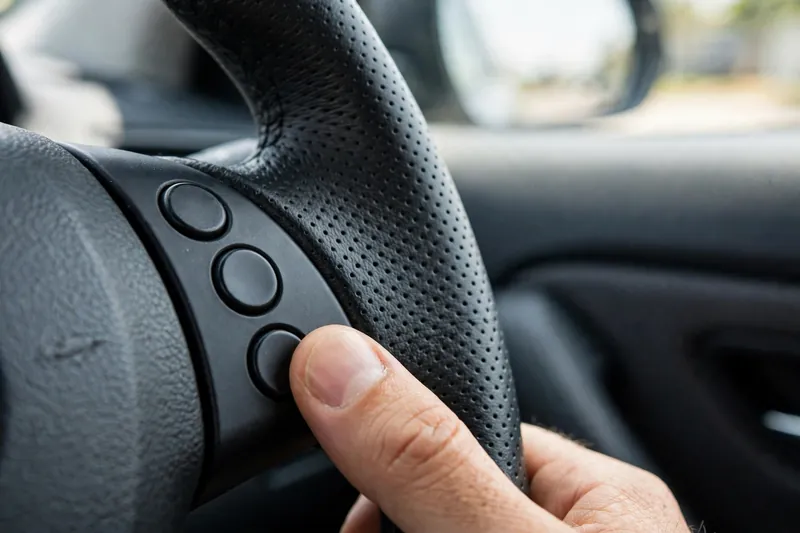
The buttons vary by make, but the pattern is the same on almost every car. ON/OFF arms the system. SET stores your current speed as the target. RESUME brings back the last set speed after you have braked — useful at a junction, dangerous if you have forgotten how fast it was. CANCEL switches the system off without erasing the stored speed. And the brake pedal always cancels it instantly, as does the clutch on a manual. Your input always overrides the system: press the accelerator and you take over; lift off and cruise takes over again.
If the buttons do nothing at all — no light, no response — the fault is usually not the mechanism but a switch, a fuse or a sensor. See cruise control not working for the checks, in cheapest-first order.
What adaptive cruise control adds
Adaptive cruise control (ACC) keeps the same speed-holding loop and adds a second one: a forward-looking sensor that measures the distance and closing speed to the vehicle ahead, and a rule that says "never get closer than the gap the driver chose". The two loops run together. With a clear road, the system holds your set speed. With a slower car ahead, it switches to gap control — easing off the throttle, and applying the brakes if needed — until the lane clears, then it accelerates back to your set speed.
The sensor is usually millimetre-wave radar, operating at 76–77 GHz, mounted behind the front grille or badge. Radar measures range by timing how long its signal takes to bounce back, and it can see 160 metres ahead in rain and fog — the rated range of Bosch's mid-range radar sensor (0.36–160 m); long-range sensors reach 250 metres. Some systems use lidar (laser) or cameras instead, or fuse several sensors together so the car can tell a vehicle in its own lane from one in the next lane. Cameras read lane markings and signs; radar is better at distance; together they are steadier than either alone.
The gap you choose is usually a time gap, not a distance — most newer systems offer about 1.0 to 2.5 seconds. A time gap is smarter than a fixed distance because it grows with speed. At 60 mph (26.8 m/s), a 2-second gap is about 54 metres; a 1-second gap is about 27 metres; a 2.5-second gap is about 67 metres. At 30 mph the same settings give gaps half as long — which is exactly how a careful driver behaves.
Modern ACC also works in stop-and-go traffic on many cars, slowing to a standstill behind the car ahead and moving off again when it does — though some systems need a tap on the accelerator or the resume button to get going after a stop. And there are limits: many systems cap how hard they will brake on their own, around 3 m/s² on some, and hand the car back to you for anything harder. ACC is a driving aid, not a driver.
Whether holding that steady speed also saves fuel is a separate question — the studies say a little, on flat roads. See does cruise control save gas for the numbers.
A short history
Modern cruise control was invented in 1948 by Ralph Teetor, a blind mechanical engineer who was annoyed by his driver's habit of speeding up while talking and slowing down while listening. He patented the device in 1950 and called it the Speedostat: a dashboard speed selector linked to the driveshaft, with a mechanism that held the accelerator steady. Chrysler offered it as a luxury option on the 1958 Imperial, New Yorker and Windsor, calling it "Auto-Pilot". Cadillac adopted it in 1959 and renamed it "Cruise Control" — the name that stuck.
Adaptive cruise control came much later. Mitsubishi built the first production system in 1992, using lidar to watch the car ahead. It spread through Japanese makers during the 1990s and reached the United States in the 1999 Mercedes S-Class. Radar became the standard sensor, and today ACC is a key part of partially automated driving — the step between cruise control and the car driving itself.
Cruise control and your speedometer
Here is a detail most drivers never notice: cruise control holds the speed the car's sensors report — the same signal the dashboard uses. And the dashboard is deliberately set to read a little high. The law allows a speedometer to read up to 10% + 4 km/h high but never low, and most cars over-read by about 3% at motorway speed. So if you set cruise to 70 mph, your true speed is probably closer to 68 mph. The system is holding the number you asked for; the number itself is flattered.
That is not a fault, and it is worth knowing for two reasons. First, if you want to know your true speed, compare the dashboard with GPS: our car speed test shows both numbers live, and the gap is usually 2–4 mph at motorway speed. Second, it means cruise control is a poor tool for driving exactly at the limit. Setting 70 mph in a 70 mph zone and trusting the dashboard keeps you legal with room to spare — which is exactly what the makers intended.
What it cannot do
- It does not steer. Cruise control — even adaptive — only controls speed. Lane keeping is a separate system, and on cars without it, the car will happily drive straight off a bend at the set speed.
- It does not see everything. Radar and cameras track moving vehicles well, but stationary objects, sharp bends and sudden cut-ins can catch the system out. It reacts to what its sensors report, not to what you can see.
- It does not replace you. The driver stays responsible at all times. The system is designed to be overridden instantly — brake, steer, or press the accelerator and it yields.
Used for what it is — a steady-speed holder for open roads — it is one of the most reliable systems in the car. Used as a substitute for attention, it is not.
FAQ
Questions, answered.
01 What does cruise control actually control? +
The throttle — and on adaptive systems, the brakes too. A conventional system reads your road speed from a wheel or transmission sensor, compares it with the speed you set, and opens or closes the throttle to close the gap. It does not steer, and it does not watch the road. Adaptive cruise adds a forward sensor that watches the car ahead and slows you to keep a chosen gap.
02 How do I turn cruise control on? +
On most cars, press the cruise button on the steering wheel to arm the system, get to the speed you want, then press SET. The car holds that speed until you tap the brake, press CANCEL, or switch it off. Pressing RESUME brings back the last set speed after you have braked. On a manual, pressing the clutch cancels it too. The exact buttons vary, so your handbook is the final word.
03 What is the difference between cruise control and adaptive cruise control? +
Conventional cruise control holds one fixed speed until you intervene. Adaptive cruise control holds your set speed when the road is clear, but slows down when it catches a slower vehicle ahead, keeps a driver-chosen gap — usually a time gap of about 1.0 to 2.5 seconds on newer systems — and speeds back up when the lane clears. Many modern systems also work in stop-and-go traffic. The driver still has to steer and stay in charge.
04 Does cruise control use the brakes? +
Conventional cruise control does not — it can only close the throttle and let the car slow on its own, so it cannot hold speed down a steep hill. Adaptive cruise control can apply the brakes, which is how it keeps the gap to the car ahead and holds speed downhill. Many systems limit how hard they will brake on their own — around 3 m/s² on some — and hand control back to the driver for anything harder.
05 At what speed does cruise control work? +
Most systems need a minimum speed to engage — on many cars roughly 25 mph — and will not work below it. The upper limit is your car's top speed, but the useful range is motorway and open-road driving. Some modern adaptive systems work down to a standstill in stop-and-go traffic, resuming when the car ahead moves, though some need a tap on the pedal or the resume button to get going again.
06 Is adaptive cruise control really that useful? +
For motorway and open-road driving, yes — that is where it earns its keep. Conventional cruise control only holds a set speed, so you cancel it every time traffic slows. Adaptive cruise control holds the set speed when the road is clear and slows to keep a gap when a slower car is ahead, using radar, and many systems work in stop-and-go traffic. It cuts fatigue and the speed adjustments of motorways. But it is a driving aid, not autopilot: it does not steer, and you stay in charge.
07 Does adaptive cruise control brake immediately if the car ahead brakes suddenly? +
It reacts quickly, but it cannot guarantee a stop. The radar or camera spots the car ahead slowing and the system brakes — on some systems up to a deceleration limit of about 3 m/s² — and in stop-and-go traffic it can bring the car to a standstill. But a car braking hard in front of you, a sudden cut-in, or a stationary object can exceed what the sensors see and what the system is allowed to do. It assists your braking; it does not replace it, so stay alert.
Related tools
Check the speed it holds, with GPS.
Sources
Where the facts came from.
- Wikipedia — Adaptive cruise control (history of ACC)
- Bosch — Mid-range radar sensor data sheet (MRR front: 76–77 GHz, detection range 0.36–160 m)
- Electronic Specifier — Bosch driver assistance systems (Bosch long-range radar LRR3: range up to 250 m)
- Toyota — Mirai Quick Reference Guide (Dynamic Radar Cruise Control) (distance settings at 50 mph: Long approx. 160 ft / 50 m, Medium approx. 130 ft / 40 m, Short approx. 100 ft / 30 m — about 2.2, 1.8 and 1.3 seconds)
- IEEE Technology Navigator — Adaptive Cruise Control Systems (77 GHz FMCW radar, set-speed/set-gap control law)
- Clemson Vehicular Electronics Laboratory — Adaptive Cruise Control (500 ft detection, 3 m/s² decel limit, brake/clutch disengage)
- iDriveCertified — What Is Adaptive Cruise Control? (feedback loop, sensor types, minimum speed)
- National Inventors Hall of Fame — Ralph Teetor (1948 patent, 1958 Imperial, Cadillac 1959)
- Stacker — From Cruise Control to Self-driving Mode (Mitsubishi ACC 1992, Mercedes US debut 1999)
Last checked: 23 November 2026.