Blog · Diagnosis
Speedometer not working: causes, diagnosis and what to do
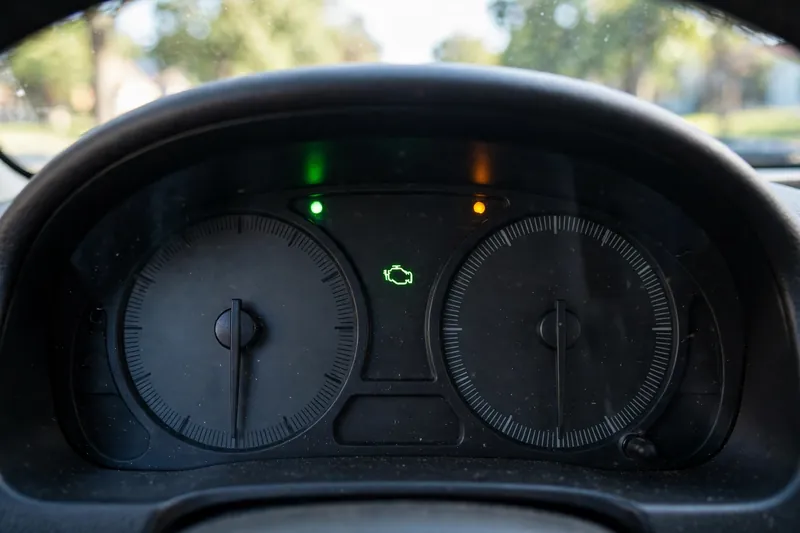
A speedometer that reads zero, jumps around, works intermittently or reads the wrong speed usually has a problem with the speed signal, the wiring, the power supply or the cluster itself. The exact symptom matters: a needle stuck at zero points to a different fault than a gauge that reads 10 mph high after bigger tyres were fitted.
How a speedometer gets its number
A modern speedometer is the end of a three-stage chain. First something generates a speed signal: a vehicle speed sensor on the transmission output shaft, or — on newer cars — the ABS wheel-speed sensors at each wheel hub. The sensor counts how fast a toothed ring turns and sends pulses. Second, a control module (the powertrain control module, the engine control unit, or the ABS module) turns those pulses into a speed. Third, the instrument cluster displays it. A breakdown at any point — the sensor, the wiring in between, or the cluster — leaves you with a dead or erratic reading.
Older cars are simpler and different: a mechanical cable runs from the transmission to the back of the cluster and spins the needle directly. If that cable frays, kinks or breaks, the needle stops. Knowing which system your car has matters, because the checks are different — and if you are not sure, the year usually tells you: cable-driven speedometers largely disappeared from new cars in the 1990s.
What the symptom tells you
Start with what the gauge actually does. The pattern narrows the fault before you touch a tool.
| What you notice | Likely cause | Check first |
|---|---|---|
| Needle at zero, odometer frozen too | Speed signal missing: sensor, wiring or fuse | The fuse, then a code scan |
| Needle dead but odometer still counts | Gauge or instrument cluster fault | Have the cluster tested |
| Speedometer and ABS light both on | Wheel speed sensor or ABS fault | A scan of the ABS system |
| Check engine light on with a dead speedometer | Speed sensor fault | The stored trouble code |
| Works intermittently | Wiring, connector, sensor heat failure, cluster solder joint | Connectors and wiring |
| Needle jumps or bounces | Mechanical cable, damaged speed gear, noisy signal, tone ring | Cable, tone ring, wiring |
| Drops out over bumps | Loose connector, damaged wiring, ground, fuse-box connection | Connectors and grounds |
| Reads wrong by a consistent percentage | Tyre diameter, axle ratio, calibration, coding | Tyre size, then recalibration |
| Stopped right after a repair | Disturbed connector or blown fuse | The connectors and the fuse |
Two clues are worth more than the rest. If the ABS light is on as well, the fault is almost certainly a wheel-speed sensor or the ABS system, because on many cars the speed signal comes from those same sensors. And if the reading changed by a steady percentage the day the tyres were changed, it is not a broken part at all — it is a size or calibration mismatch, which a recalibration fixes.
The common causes, in order of likelihood
Failed vehicle speed sensor. The most frequent cause on modern cars. The sensor lives in a harsh place — vibration, heat cycles, road debris — and when it fails internally it stops generating pulses. The check engine light often comes on at the same time, and the car may also shift harshly or lose cruise control, because the transmission uses the same signal.
Failed ABS wheel-speed sensor or damaged tone ring. The sensor reads a toothed tone ring at the wheel hub. A cracked ring, a damaged bearing encoder or a failed sensor sends bad data, and the ABS and traction control lights usually come on with it.
Blown fuse or lost cluster power. The fuses that protect the cluster are usually labelled Instrument Panel, Dash or Gauges, in a fuse box under the bonnet or beneath the dashboard. A blown fuse cuts the 12-volt supply and the whole display can go dark. Replace it with one of the same rating; if it blows again, there is a short or a component drawing too much current.
Damaged wiring or corroded connectors. Wiring chafes where it passes through tight spaces, corrodes near the transmission or wheel hubs, and — in cars parked for a while — gets chewed by rodents. A needle that flickers between speeds often points to wiring rather than the sensor, and a gauge that drops out over bumps points to a loose connector or a bad ground.
Instrument cluster failure. The stepper motor that moves the needle can fail, the circuit board can develop a cracked solder joint, or the cluster's logic can corrupt. If the speed signal is confirmed to be reaching the dashboard and the gauge still does not move, the cluster is the fault.
Wrong tyre or wheel size, or wrong axle ratio. The speedometer assumes the factory tyre circumference. Change it and the maths changes with it — the sensor never knows. This one does not make the needle jump; it makes it read wrong by a steady percentage.
Low battery voltage or a charging fault. A weak battery or a failing alternator can make the cluster behave erratically, especially after a battery swap, when the gauge may freeze or read wrong until the cluster is reset or updated.
What to check first, in order
Start with the cheap and simple checks, then move on.
1. Look at the dash. Is the odometer frozen too? Is the check engine light on, or the ABS light? These clues point to the likely cause before you open the bonnet.
2. Check the fuse. Find the fuse labelled for the instrument panel, pull it and look at it. Replace a blown one with the same rating. If it blows again, stop — there is an electrical fault that needs tracing.
3. Scan for codes. An OBD-II scanner reads the stored trouble codes. A speed-sensor fault usually stores one (P0500 is the common vehicle-speed-sensor code). A code is a starting point, not a diagnosis, so do not replace parts on a code alone.
4. Inspect wiring and connectors. Look at the sensor connector and nearby wiring for damage, rust or a loose fit. Never work under a car supported only by a jack.
5. Compare against GPS. A phone GPS speed reading on a steady road tells you whether the dashboard is wrong and by how much. Mount the phone before you drive, and have a passenger record the numbers. Our car speed test walks through the comparison, and our speedometer error calculator turns the two numbers into a percentage and a correction table. If you want every check in one place, the free speed tools list the GPS test, the error calculator and the odometer together.
6. Get it diagnosed. If nothing obvious turns up, a technician can test the sensor, the wiring and the cluster with a scan tool that reads live vehicle-speed and individual wheel-speed data.
What it typically costs
Costs depend on the vehicle, where you live and the quality of parts used. The ranges below are reported ranges as of November 2026 — Jerry's modelled estimates, not manufacturer or dealer prices — so treat them as a guide rather than quotes. A vehicle speed sensor usually runs $120–$350 fitted. A wheel speed sensor is $150–$400 per wheel. A recalibration after a tyre change is $75–$200. Wiring or ground repairs are $100–$300. A stepper motor or cluster rebuild is $200–$450 for the motor and $250–$900 for a rebuild. A mechanical cable on an older car is $60–$220. Get an itemised quote before you agree to the work, and ask whether the price includes the code scan — diagnosis and repair are often billed separately.
One warning: if your check engine light is flashing rather than steady, that is a different matter. It usually points to an engine misfire and needs prompt attention, so do not treat it as part of the speedometer problem.
FAQ
Questions, answered.
01 Is it safe to drive with a broken speedometer? +
Not for long. Without a working speedometer you cannot tell whether you are inside the limit, and in most places driving with a dead speedometer is an offence in itself. Use a phone GPS speed reading as a short-term stopgap to get to a repair, mount the phone before you drive, and get the car diagnosed promptly.
02 What is the most common cause of a dead speedometer? +
A failed vehicle speed sensor, usually. It sits on the transmission output shaft or at a wheel hub, in a hot, vibrating, exposed place, and when it stops sending pulses the car has no speed signal at all. A blown fuse and damaged wiring are the next most common, and both are cheap to check before you replace anything.
03 Why does my speedometer work but the odometer does not? +
That split points to the instrument cluster rather than the speed signal. If the odometer is frozen while the needle moves, the fault is usually in the cluster's own logic, display or gear mechanism. If both are dead together, the speed signal itself is missing — sensor, wiring or fuse.
04 Can a blown fuse stop the speedometer? +
Yes. The instrument cluster is protected by one or more fuses, usually labelled Instrument Panel, Dash or Gauges, in a fuse box under the bonnet or beneath the dashboard. A blown fuse cuts the cluster's power and the whole display can go dark. Replace it with one of the same rating — if it blows again, there is a short to trace.
05 Why did my speedometer stop after a tyre change? +
Because the speedometer assumes a fixed tyre circumference. A larger tyre covers more ground per revolution, so the car thinks it is going slower than it is; a smaller tyre does the opposite. If the reading changed by a consistent percentage right after the change, the tyre size or the calibration is the cause, not a broken sensor.
06 How much does it cost to fix a speedometer? +
It depends on the fault. Typical reported ranges, as of November 2026 (Jerry's modelled estimates, not manufacturer or dealer prices): a vehicle speed sensor $120–$350 fitted, a wheel speed sensor $150–$400 per wheel, a recalibration $75–$200, wiring or ground repairs $100–$300, and a cluster rebuild $250–$900. Prices vary by vehicle and region, so treat these as ranges and get a quote before you agree to work.
Related tools
Test it yourself, before the garage.
Sources
Where the facts came from.
- ProStreetOnline — Why Is My Speedometer Not Working? Causes, Diagnosis, and Repair Costs (18 causes; symptom table: zero = lost signal, intermittent = wiring, jumps = cable/tone ring, consistent % error = tyre size/calibration)
- Engineer Fix — What Would Cause My Speedometer to Stop Working? (VSS most frequent; ABS wheel-speed sensor failure also lights ABS/traction; blown fuse labelled Instrument Panel/Dash/Gauges; mechanical cable on older cars)
- AutoSpecsHub — Speedometer Not Working: Causes and What to Check First (diagnosis order: dash clues, fuse, OBD-II scan, wiring, technician; phone GPS as short-term stopgap; flashing CEL = misfire)
- Jerry — Malfunctioning Speedometer: Causes and Solutions (typical repair ranges: VSS $120–$350; wheel speed sensor $150–$400 per wheel; reprogram $75–$200; wiring/grounds $100–$300; cluster rebuild $250–$900; stepper motor $200–$450; cable $60–$220 — modelled estimates, vary by vehicle and region)
- My Auto Shop — Expert's guide to speedometers (the cable system began to be phased out in the 90s as ABS and wheel speed sensors arrived)
Last checked: 23 November 2026.